





Kent Cricket announced the sad passing of former Kent & England bowler, Alan Brown, at the age of 90 today.
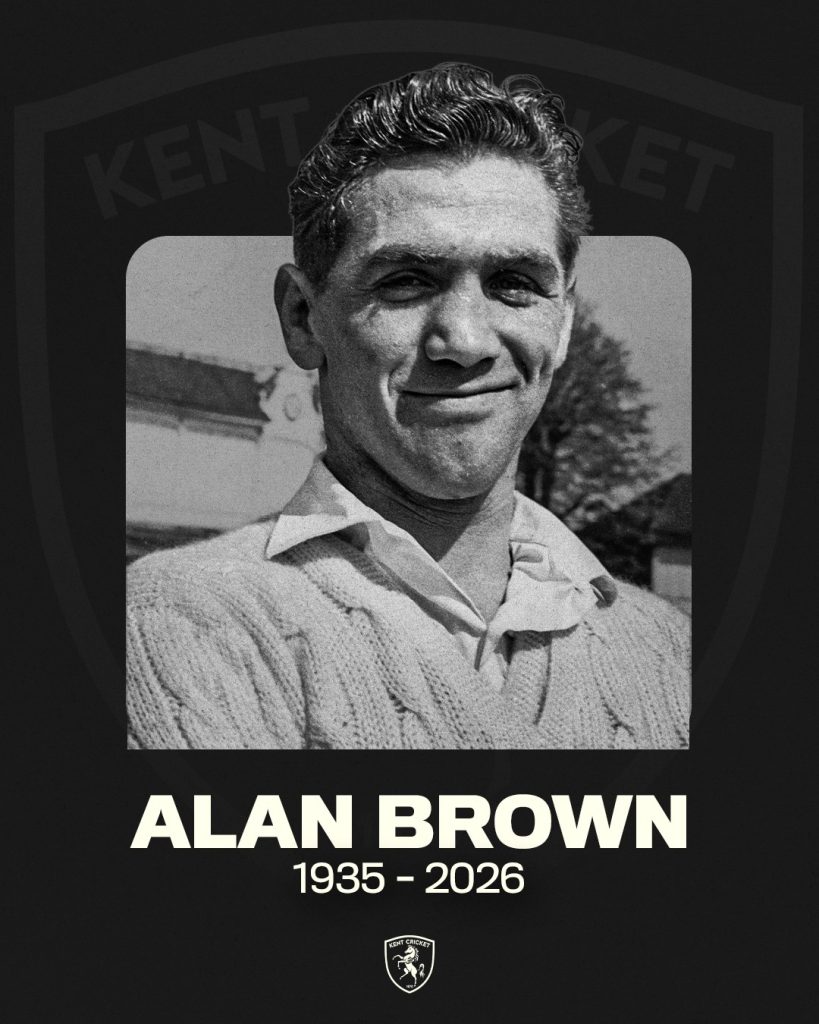
At 6ft 3in, Alan was a tall, fast bowler, remembered for the tremendous drag that completed his action, and who could on his day bowl at a fearful pace. More than many of the pace bowlers of his period, over 30% of Brown’s dismissals came by hitting the stumps.
He took 707 first-class wickets for Kent in 237 appearances from 1957-1970, and is 17th on Kent Men’s all-time list of first-class wicket-takers. In his final season as a Kent cricketer, he was a part of the side that won the County Championship for the first time in 57 years.
Always good company with plenty of well-remembered stories, he remained a popular, congenial figure into retirement.
Alan was the only Kent player who could boast a mining background, a famous traditional source of fast bowlers. However, while there is a mining tradition in Kent, Brown’s was Nottinghamshire. He was born in the mining village of Rainworth, two miles east of Mansfield.
In August 1954 his country called him and he became 2305525 Gunner Brown A, in the Royal Artillery for National Service. After a couple of weeks Brown found himself at the Milton Barracks in Gravesend where he was to spend all his two years, playing cricket for the local Imperial Paper Mills (IPM) team.
Outstanding fast bowlers are always at a premium, so one as promising as Brown soon became well known in the Gravesend area. Once National Service was over, Brown was to be found at Eltham where would-be Kent cricketers went for coaching and from where he was recommended for a trial at Canterbury.
There Brown bowled in the nets to members of Kent’s first-team, including Bob Wilson who, battered after just three balls, did not need much convincing as to his talent. This was at the precise moment that Colin Cowdrey and Les Ames had come together to manage Kent’s affairs, and mindful that technically Brown was still on Nottinghamshire’s staff, they wrote asking for his release to sign for Kent.
In May 1957, his Kent career began with a Second XI match at Lord’s. He took five wickets and was promoted to the first-team at Fenner’s against Cambridge University. He took two wickets. That season he played nine first-team matches, interspersed with 11 matches for the Second XI. He came away with 27 first-class and 36 Second XI wickets.
In 1958, Alan established himself as a regular in the side. He played 21 matches taking 48 wickets (averaging 26.62), and took his first five wicket haul ironically at Trent Bridge against his home county. A heel injury in 1959 cost him six weeks of the season. Returning to the side, he bowled better and better and at Folkestone against Nottinghamshire (again) had the best performance of his career to-date. In one spell he took four wickets in five balls and nine wickets all told in the match as Kent won by an innings. His season total was 61 wickets.
In 1961, Alan was awarded Kent Men’s Cap number 135, and found himself selected for the MCC (England Men) tour to India and Pakistan that Winter. He played in two Tests, one each in Pakistan and India, taking 3 for 27 in the second innings of his first match.
Returning home for the 1962 season, Brown topped the Kent bowling averages with 55 wickets (averaging 22.07). But he missed nine matches through injury. 18 of these wickets were taken in a remarkable Maidstone Week – against Leicestershire (1 for 84 & 5 for 33) and Lancashire (7 for 43 & 5 for 69).
After an injury-hit 1964, Alan came back fully fit for 1965 and had the most successful season of his career, spearheading the attack with 116 wickets, averaging 19.04. He took 7 for 45 versus Nottinghamshire at Trent Bridge, while he had another success at Maidstone with 7 for 65 and eleven wickets in the match against Essex.
1970 transpired to be Brown’s final season as a cricketer. His last first-class match was in Canterbury Cricket Week, while his very last match was a Sunday League game at Bournemouth in September. He did not play in the Surrey match that won Kent the County Championship, but does appear on the famous photograph taken at the Oval of the successful Kent squad. He and David Sayer were granted a joint testimonial in 1971.
Paralleling the cricket was Alan Brown’s career as a Kent non-league footballer, one of the last to successfully manage the two. He never really aspired to anything higher, although league clubs were interested – notably Arsenal early on and Gillingham. He joined and first played for Gravesend and Northfleet in 1957/58.
Initially a centre-half, his form was transformed moving up to centre-forward. In four seasons (1957/58-1959.60 & 1967/68) he scored for the first team 22 goals in 43 matches; at all levels he scored 106 goals for the club. From Stonebridge Road his career progressed to Margate (1960/61 – 28 goals in 35 appearances), Canterbury City (1961/62 & 1962/63 – five goals in 13 appearances in the first season). Deal Town (1963/64 – top scorer), Bexley (1965/66), Canterbury City (again 1967/68), Whitstable Town 1968/69 (three goals in six appearances before he promptly retired) and out of retirement one season (1969/70) returning to Deal Town, where that season he was the top scorer.
Following retirement from cricket, Alan was employed in both the then major local industries – paper, a salesman for IPM and cement, a manager at APCM. Finally, he worked for the Post Office.
The thoughts of everyone at Kent Cricket are with Alan’s friends and family at this desperately sad time.