





With the sad news that former Gillingham defender Richard Green has passed away, we look back on what a great defender and man he was.
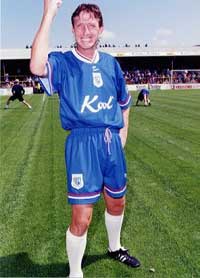
I was incredibly fortunate to see Green play the majority of his games for The Gills back in the nineties.
Green had signed for the club from bitter rivals Swindon Town in the summer of 1992 – bearing in mind that wasn’t the most popular of decisions among the Gillingham fanbase at the time.
However, they were very much soon won over by the towering central defender’s attitude and desire to give his all for the shirt.
He’d started his career at Shrewsbury Town in 1986 and after five seasons at the Salop side made the move to The County Ground but injuries and a lack of opportunities saw him move on within twelve months to The Gills.
Then manager Damien Richardson was keen to land the then 24 year old and having only recently been appointed into the Gillingham hotseat himself, the manager saw Green as one of the building blocks for his side.
Despite Green scoring twice on his debut against Cardiff City, Richardson’s time at Gillingham came to an abrupt end and he was replaced by Glenn Roeder as player/manager in the long term with Paul Clark having been handed the reins for a few weeks as caretaker. A turbulent season saw Roeder himself shown the door in the summer of 1993 with Mike Flanagan coming in.
Flanagan was to be the fourth manager Green would play under with Neil Smillie given the caretaker role from March until the end of the 1994/95 season.
Tony Pulis was Green’s sixth and final Gillingham boss and arguably got the best out of the central defender.
It was under Pulis that Green really came into his own, cementing his place in the side that were desperate to keep clean sheets.
Green played the game the right way, he was tough, determined and didn’t shown any fear to an opposing striker. If he got knocked down, he was straight back up. The game is so different from what it is now. Defenders bled for the badge and didn’t want to show any form of weakness. There was a real steel about defenders like Green and you certainly wouldn’t have seen him rolling about on the ground feigning injury.
Off the pitch, he was warm and approachable and you could see why he would become a fan’s favourite. Back in those days, it wasn’t uncommon for players to come and have a pint with fans after the game and Green would be leading the line when it came to rubbing shoulders with those that supported him and the team.
That was the ethos of the Pulis sides. The manager wanted unity and Green bought into that.
Green was only to have a couple of seasons under Pulis, but in that time the two epitomised one of the best times for fans supporting the club. Fans felt like they were very much part of the side, that the players shared their passion for success.
It’s rare that club and fans sing off the same hymn sheet, but I remember those times fondly, standing on the terraces behind the goal at the Rainham End.
Was it all sunshine and roses? Of course not! The club won, the club lost and everything in between, but the fans and the players were united in their belief that Gillingham could go on to bigger and better things.
When Green finally left the club for Walsall in 1998, the baton being passed on to the likes of Barry Ashby, Guy Butters and Adrian Pennock, the mould and template was there for them to follow. Green had made that mould.
Pulis wanted Richard Green three times over and the trio were to go on and take the club to the promised land of the second tier of English football.
I was fortunate to spend some time chatting with Green in the 90s about all things football, life and everything else. He wasn’t the loudest of characters, but he had a real presence about him.
I admired him as a player and as a person. In a world where players didn’t earn fortunes, he was generous in so many ways and undoubtedly he should go down in history as one of the club’s legends.
When he passed away on Thursday, aged just 58, it came as a real shock to me and so many Gillingham fans.
The loss of Green shows us all how short life is and how we should make the most of footballers and people like him whilst they are still with us.
The stats will show that he played 253 times for Gillingham, scoring 17 goals in the process, but they won’t tell you what a great defender and bloke was.